
“It is difficult not to recognize the signs that African Americans are in the midst of a cultural renaissance” — Henry Louis Gates Jr. (born 1950), an American literary critic, professor, director of the Hutchins Center for African and African American Research at Harvard University (1997).
The Harlem Renaissance began during the Progressive Era, a period spanning from the 1890s to the 1920s in which the White Anglo-Saxon Protestants (WASPs) were predominant and considered as ideal in the United States. The Progressive Era was characterized by increased awareness of societal issues and calls for greater equality and fairness for all Americans. However, slightly preceding that time period, the first African American senator, Hiram Revels, had been elected in 1870, while Blanche K. Bruce, another African American had served as a senator from 1875 to 1881. Furthermore, it is important to acknowledge that segregation was in place since 1896—with the creation of “separate but equal” facilities in Plessy v. Ferguson— allowing for racial segregation in public facilities. This law persisted until the 1960s with the passing of the Civil Rights Act in 1964, prohibiting discrimination based on race, color, religion, sex, or national origin in various areas, including employment and education.
Moreover, the early 20th century was also characterized by a significant phenomenon known as the Great Migration. The event saw record numbers of Black individuals leaving the South to escape the oppression of the Jim Crow Laws and to take advantage of urban economic opportunities. Many settled in large cities, such as New York, Detroit and Chicago, where they could find jobs in industries like automobile manufacturing, steel, and meatpacking. This migration led to a significant increase in literacy rates among African Americans and the creation of national civil rights organizations, such as the NAACP, founded in 1909 by W.E.B. Dubois.
The 1920s were also characterized by economic prosperity and a great artistic and cultural dynamism: The Roaring Twenties. The American economy experienced a period of rapid growth and expansion, partly due to the euphoria following World War I. Europe also experienced this feeling of novelty and similar growth, with the “années folles” in France. However, the Wall Street Crash of October 1929 sparked the Great Depression and put an end to this period of flourishing. It marked the beginning of a decade of poverty, high unemployment, and hardship. Due to the lack of financial support for artistic and cultural programs, the Harlem Renaissance experienced a major setback, resulting in many artists and writers seeking alternative means of income. Furthermore, the economic downturn contributed to a reduction in the number of publications willing to showcase the works of African American writers and artists. Despite the challenges, the Harlem Renaissance continued to have a lasting impact on American culture. The objectives of the movement also changed: Prior to the economic downturn, the Harlem Renaissance aimed at celebrating African American culture and promoting racial pride, but after the Great Depression, many artists and writers started to explore more political themes, such as poverty, inequality, and social justice.
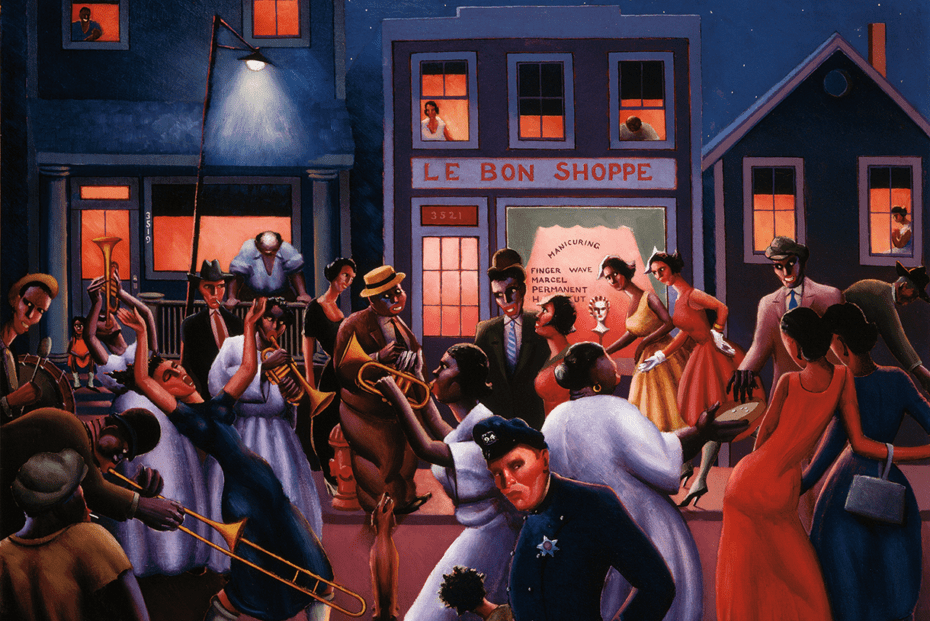
Finally, it is crucial to acknowledge that while the 1920s were a time of modernity, they were also a period of racial unrest, with the rise of the second Ku Klux Klan (1915-1944), as well as white supremacist leagues. These groups were celebrated in popular novels or films, such as Birth of a Nation, perpetuating racist ideologies and contributing to the oppression of African Americans. The Harlem neighborhood gained from this migration and from these carefreeness years, transitioning from an upper-middle-class white neighborhood to a predominantly Black neighborhood. Sugar Hill, located in the northern part of Harlem, was a wealthy neighborhood where numerous prominent figures of the Harlem Renaissance settled, including W.E.B. Dubois, Duke Ellington—and later Thurgood Marshall. The convergence of the white and black populations contributed to the growth of the area and set the stage for a major cultural movement known as the “Harlem Renaissance”, that lasted from 1917 to 1936. At the time, the Harlem Renaissance was known as the “New Negro Movement”, named after The New Negro, a 1925 anthology edited by Alain Locke. Some of the key figures of the movement included writers like Langston Hughes, Zora Neale Hurston, and Countee Cullen, and musicians like Duke Ellington and Louis Armstrong.
Given the prevailing social and cultural climate of the time, it is not surprising that the Harlem Renaissance emerged during a period of significant social progress and reforms, ushering in a new spirit of self-determination and pride, a new social consciousness, and a new commitment to political activism for African American all across the country, challenging the racist stereotypes of the Jim Crow South. Therefore, it is worth considering whether the Harlem Renaissance had an impact on the perception of African Americans by the predominantly white audience and whether it had any effect on ethnic relations in the United States. To what extent were race relations impacted by the Harlem Renaissance? First (I), “The New Negro Movement”, as creating a new African American identity will be studied, with a focus on the flourishing of African American culture and the fight against racial prejudices. Then (II), black culture as part of the mainstream American society will be analyzed, and questions such as “how to break down between the two communities?” and “what was the role of white patronage?” will be tackled. Lastly (III), the social, political and cultural legacy that the Harlem Renaissance left to the following decades, and what is left of it today, a hundred years later will be considered.
MORE: https://theodora-poulot.com/wp-content/uploads/2023/12/the-harlem-renaissance-and-race-relations.pdf
 プロテオドラ Theodora Poulot