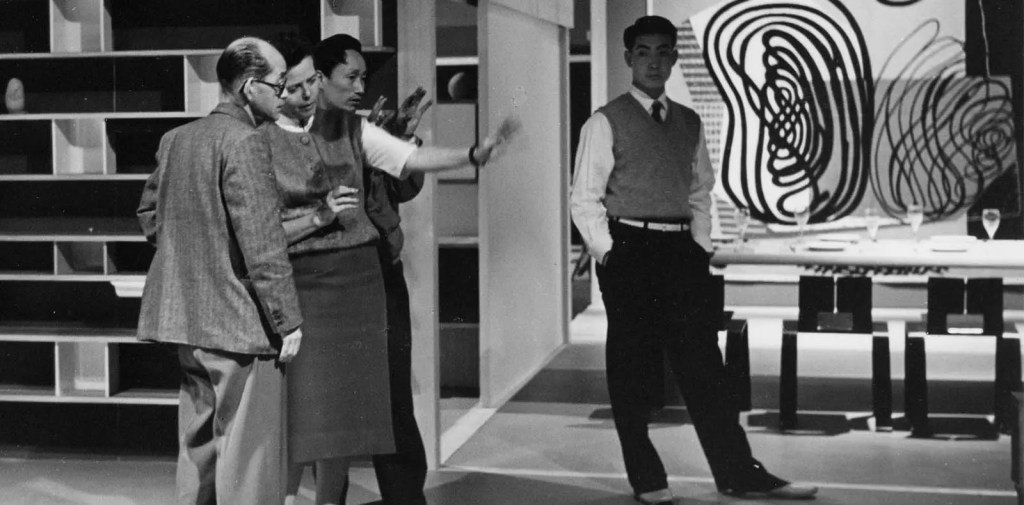
During my internship at Villa Kujoyama in Kyoto, Japan, I decided to contribute to the Kyoto Journal, the longest-standing independent English publication in Japan, which covers a wide range of topics including art, culture, politics, and the environment. At a meeting to discuss the upcoming issue, I introduced the idea of featuring Charlotte Perriand and her fascination with Japan. This concept was further enriched by my colleagues, who brought in aspects of the Bauhaus movement and the Japanese minimalist vision, esteemed by many foreign architects and designers.
Therefore, this article is the outcome of my personal reflections on the topic.
Charlotte Perriand (1903-1999), French architect and designer, stands out today as a seminal figure in the evolution of modern living and the introduction of innovative materials. Still often underappreciated compared to her peers, Le Corbusier and Pierre Jeanneret, her art places a significant emphasis on rurality and the transition of society from the 19th-century paradigm to the modern framework of the 20th century. Perriand also critically examines political issues and the societal position of women, positioning herself as a prominent advocate for feminism.
Born in 1903 in Paris, Charlotte Perriand enrolled at the Ecole de l’Union Centrale des Arts Décoratifs in 1920, where she honed her skills until 1925. By 1927, her career as an interior designer was in ascent as she collaborated with Le Corbusier and Pierre Jeanneret on seminal works including Villa Church, Villa Savoye, La Cité de Refuge, and the Pavillon Suisse.
In the subsequent years, Perriand’s visionary approach earned her a spot as one of the co-founders of the French Union of Modern Artists (UAM). Her partnership with Fernand Leger in photographic research and her specialization as an architect in leisure projects, most notably the “Maison au Bord de l’Eau,” solidified her reputation. In 1940, during a period of technological advancement in Japan, the Japanese government appointed her as an advisor for industrial art, a position that led to her spending six years working in Tokyo. This period in Japan proved to be transformative, indelibly influencing her creations and professional ethos for the remainder of her life.
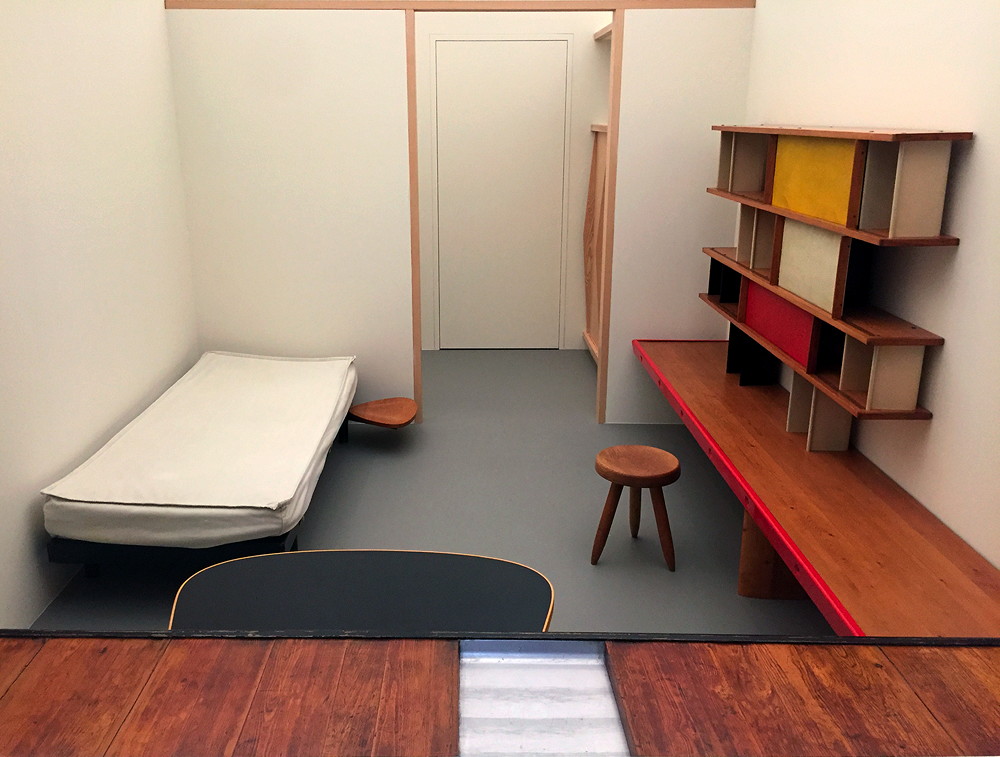
Charlotte Perriand quickly established herself as an architect with a focus on social and humanist principles, pioneering design that was accessible to all. She adeptly bridged the gap between beauty and practicality. A testament to her approach is the commission she received to furnish the student accommodations at the Maison de la Tunisie in 1952. There, in the rectangular living spaces, she introduced her bookcase—co-designed with Jean Prouvé—that served not only as an aesthetically pleasing feature but also as a subtle divider, ingeniously segmenting the room into distinct areas without bisecting the space.
As a matter of fact, in Weimar, a school of other European artists who aimed to make architecture functional had previously emerged: the Bauhaus. Founded by Walter Gropius in 1919, the Bauhaus was a seminal European artistic collective dedicated to functional architecture. A nexus for influential figures like Mies van der Rohe, Wassily Kandinsky, and Paul Klee, who each contributed to the movement’s legacy of integrating art, craft, and technology, the Bauhaus ethos was centered on the belief that design should be responsive to the needs of society and that every form should have a function.
The Bauhaus and Charlotte Perriand both shared the visionary idea of creating high-quality, affordable housing through modular construction. This concept aimed to blend functional design with the efficiencies of mass production, facilitating better living conditions for a broader population. While both European, Perriand and the Bauhaus shared an interest for Japan and the art of living in Japan.
On the one hand, Perriand discovered there a new art of living and new materials, re-envisioning her works with local elements and a sense of minimalism and finesse. She embraced the concept of ’emptiness’ in her designs, allowing space to become a defining element of her creations, such as the ‘Chaise Ombre’ and the ‘Étagère Nuage’. Additionally, her adoption of movable screens (shoji) and sliding doors (fusuma) to partition living spaces draws directly from Japanese architectural traditions. In her design, walls remain retracted during the daytime to foster a spacious communal area, while at night, beds are pulled from built-in cupboards, and the walls are closed, to transform the area into private bedrooms.
In ‘La Maison au Bord de l’Eau,’ Perriand incorporates sliding openings made of wood or glass, depending on the desired effect, showing her commitment to architecture that harmonizes indoor and outdoor spaces and allows an effortless flow between them.
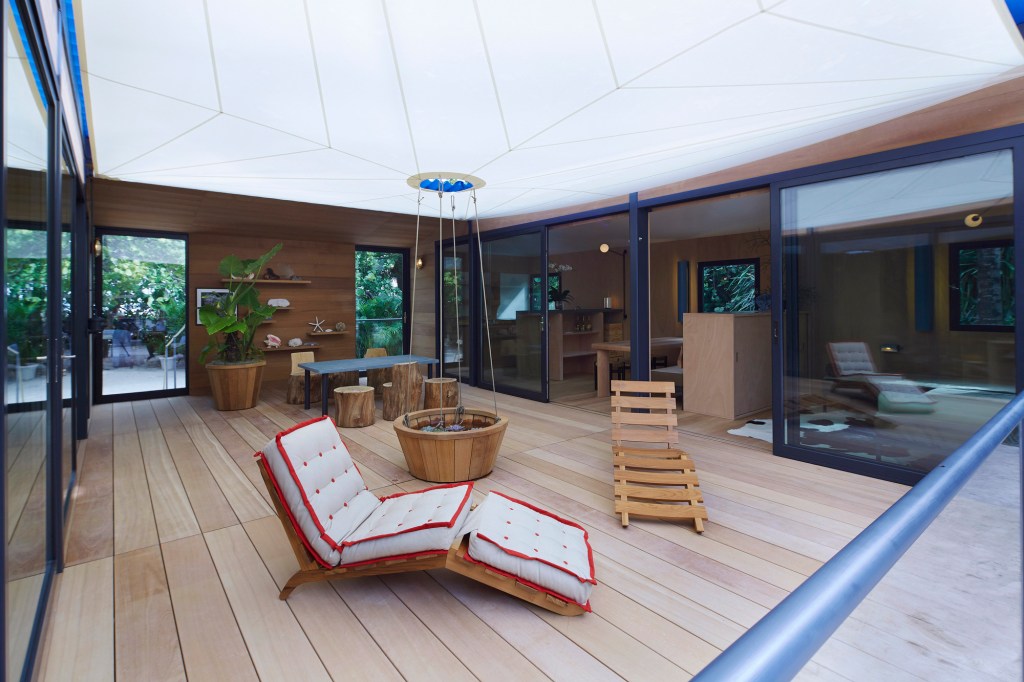
Maison au Bord de l’Eau, conceived 1934. Picture: on display for Art Basel and Design Miami, December 4th – December 8th 2013.
On the other hand, German modernists were notably drawn to the minimalist style of the Katsura Imperial Villa in Kyoto. They appreciated its simplicity and the unique approach of Japanese architects and artisans to spatial design, particularly the interplay of emptiness and fullness. In line with Charlotte Perriand’s philosophy, what’s essential is for the eye to “slide” through the room without being obstructed, as a fan’s unfolding — a metaphor for curiosity and cultural receptivity.
Therefore, the homes and designs conceived by Perriand and the Bauhaus can be regarded as expressions of the Japanese spatial concept of ma, or “in-betweenness.” The design of these spaces emerges from a thoughtful balance of presence and absence, as well as interplays of light and darkness.
But this cultural dialogue was indeed reciprocal. Japanese artists and critics such as Sadanosuke Nakada and designer Iwao made their way to Germany to immerse themselves in the Bauhaus philosophy, and in Paris, architects Junzo Sakakura and Kunio Maekawa gained experience working alongside Le Corbusier. The exchange of ideas and experiences from these interactions played a substantial role in the Bauhaus’s increasing renown within the Japanese art scene from the 1920s onward.
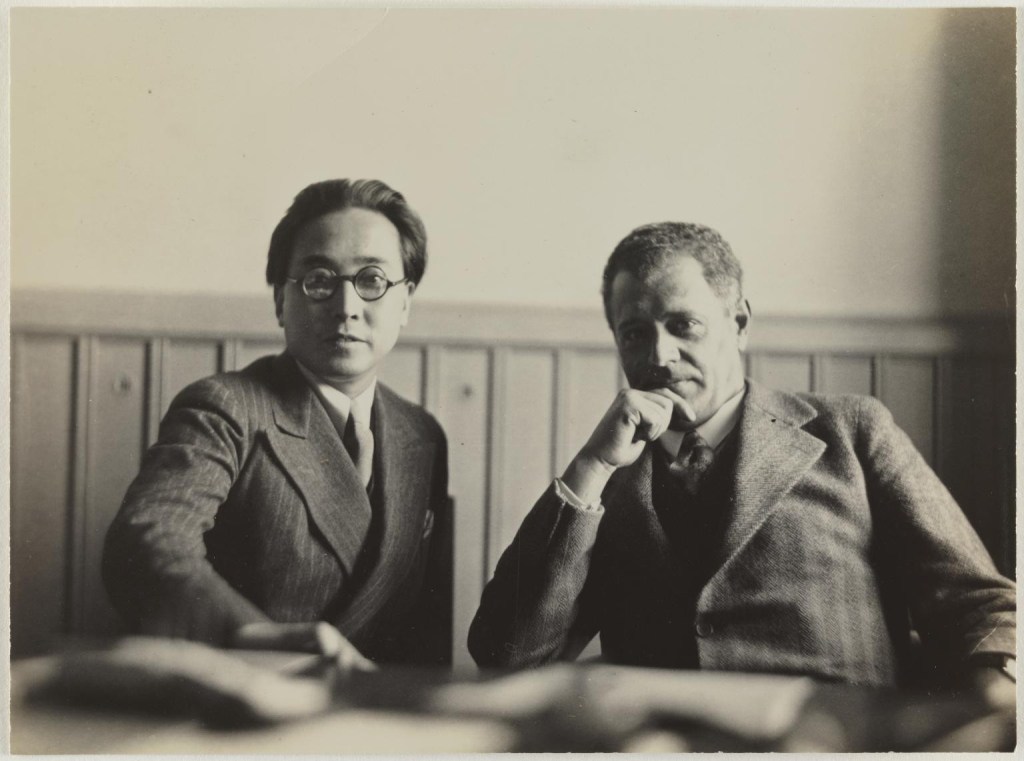
After returning to Japan, Sakakura and Maekawa successfully blended Western Modernism with traditional Japanese architectural elements. This synthesis has influenced contemporary architects like Tadao Ando, who focus on nature, the concept of nothingness, and the use of empty space to capture the essence of simplicity in his designs.
 プロテオドラ Theodora Poulot