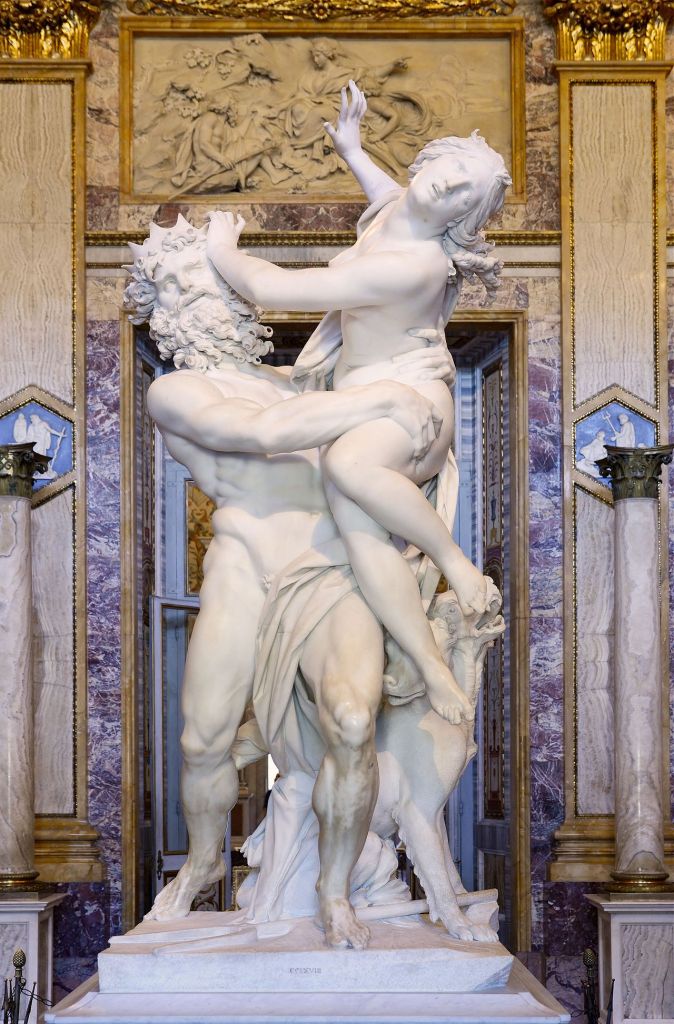
Now housed in Rome’s Galleria Borghese, Gian Lorenzo Bernini’s Rape of Proserpina (1621–1622) stands as a striking testament to the emotional and technical heights of early Baroque sculpture. Commissioned by Cardinal Scipione Borghese and completed when Bernini was just twenty-three years old, the marble group depicts the abduction of Proserpina (Persephone) by Pluto (Hades), as told in Ovid’s Metamorphoses.
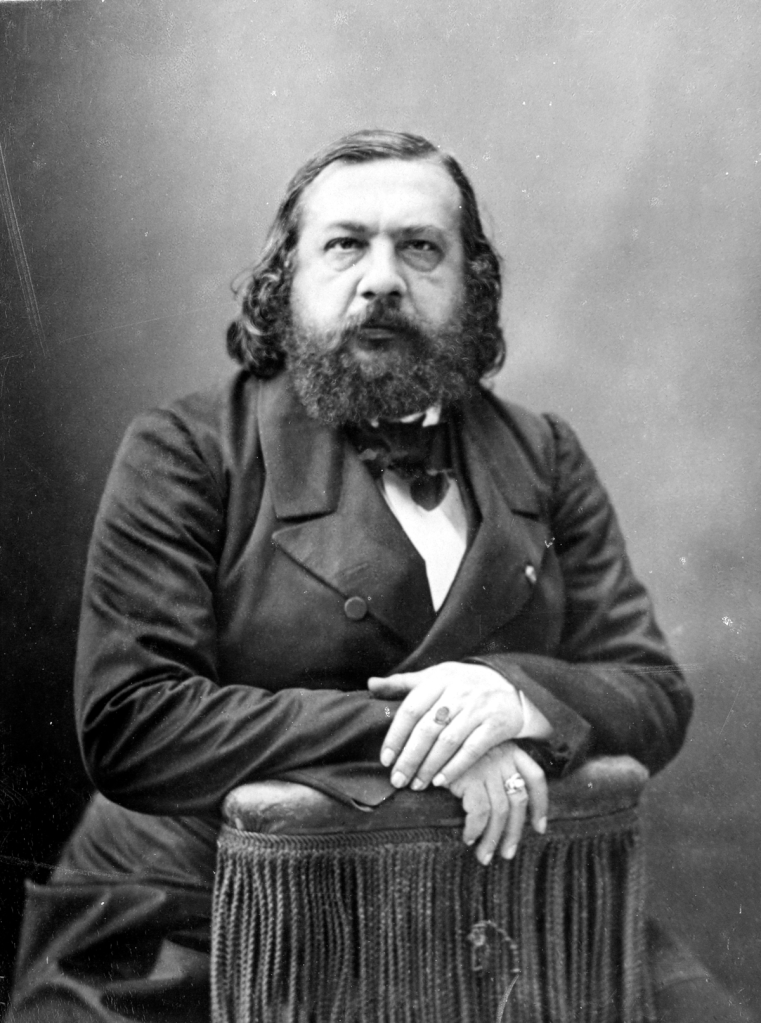
Photograph of Théophile Gautier by Félix Nadar’s studio.
The sculpture captures the drama of the myth in a single charged instant. Pluto lunges forward, gripping Proserpina’s waist and thigh with hands that seem to sink into her flesh, an illusionist feat in stone that remains one of Bernini’s most admired details. Proserpina twists away, her hair and limbs in motion, her mouth parted in a silent cry. At their feet, Cerberus, the three-headed dog of the Underworld, snarls in anticipation.
The work exemplifies key Baroque principles: theatricality, movement, emotional intensity, and tactile realism. Bernini renders not just bodies in motion, but a collision of forces—masculine and feminine, power and resistance, death and fertility. A single tear carved into Proserpina’s cheek brings the scene into human, almost cinematic focus.
This mythic abduction finds a literary counterpart in Théophile Gautier’s short story Arria Marcella (1852), in which a young man, Octavian, is drawn to a woman long dead, preserved in the ashes of Vesuvius.
A precursor to Parnassianism, Gautier’s writing evokes an atmosphere of ghostly sensuality: “a black dust, an impalpable soot clings to everything,” he writes. This intangible world stands in stark contrast to Bernini’s vision, where physical contact—Pluto’s grasp, Proserpina’s resistance—is central.
And yet, both works hinge on the theme of impossible love between the living and the dead. In Bernini’s version, the encounter is violent and fated; in Gautier’s, it is romantic and fleeting. One woman is seized against her will; the other returns briefly from the past. Both narratives end with a descent into the realm of shadows.
Viewed together, Bernini’s sculpture and Gautier’s prose reflect a shared fascination with the boundaries between life and death, touch and loss, myth and memory. In Rape of Proserpina, Bernini transforms marble into flesh. In Arria Marcella, Gautier turns ash into longing. Each artist, in his own medium, renders the ephemeral achingly palpable.
 プロテオドラ Theodora Poulot