


– Mammoth Tooth, Framed, 1961, Natural tooth, copper and brass, 9 x 25.1 x 14 cm (3.54 x 9.88 x 5.51 in) © Thaddeus Ropac
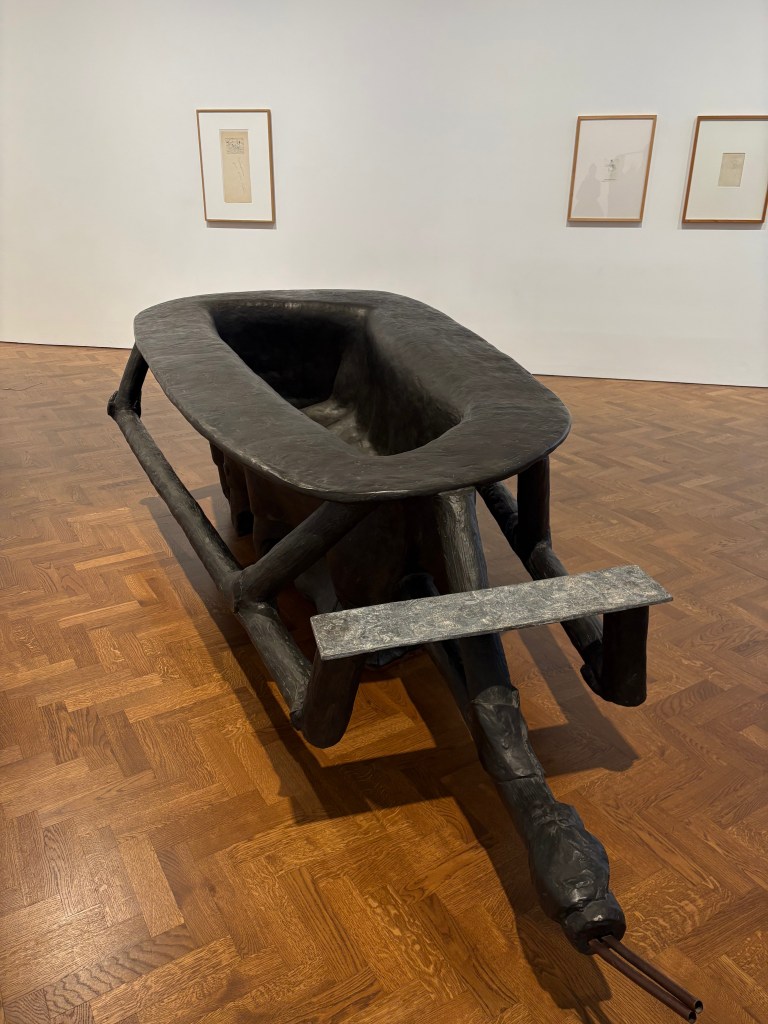
– Badewanne (Bathtub), 1961–85, cast 1987, Bronze, lead and copper, 1000 kg, 90 x 165 x 340 cm (35.43 x 64.96 x 133.86 in)
– Untitled (Soap), undated, Pencil and soap on paper, 36 x 22 cm (14.17 x 8.66 in) © Thaddeus Ropac
– Cuprum 0.3% unguentum metallicum praeparatum, 1978-86, Cast beeswax multiple with finely distributed copper, 19.5 × 10.5 × 10.5 cm (7 7/10 × 4 1/10 × 4 1/10 in) © Thaddeus Ropac.
German artist Joseph Beuys, born in Krefeld in 1921, is the subject of an exhibition at Thaddaeus Ropac London, running from 13 January to 28 March 2026.
Interested in the natural sciences from childhood and enrolled in the Hitler Youth (membership was compulsory at the time), Beuys developed a body of work in which visceral warmth and mechanical coldness collide. That tension is inseparable from a youth shaped by the Third Reich (1921–1945) and from the scars of his own wartime experience in World War II.
During the Second World War, Beuys’s plane crashed on the Crimean Front near Znamianka and he was rescued by nomadic Tatar tribesmen. The myth has it that, they wrapped his injured body in animal fat and felt to keep him from freezing. This episode underpins his repeated use of fat and felt in his work, as materials tied to insulation, warmth, protection, and survival.
The central piece of the exhibition is Beuys’s Bathtub, which marks his final project. It all began with his sculpture Mammoth Tooth, that he framed like you frame antiquities, in the core of it was placed a tooth. Beuys decided to flip the sculpture around, and realized it resembled to a bathtub. He was interested in Juxtaposition modern object metal bathtub and prehistoric object at core of it.
Other small bathtub Bathtub for a Heroine, also featured in the exhibition, features as well a chimney and female figure on top. In the early 60s, he decided he wanted to réalise bathtub monumental scale.
The bathtub, offered for sale at the gallery for £1.8m, was produced in three editions: one is held by the Pinakothek der Moderne in Munich, and another is in a private collection. The object is fully functional: it can be filled with hot water, and in principle it would radiate enough heat to warm the entire room. But that promise of comfort is immediately broken by the surface itself, with its very dark patina, its cold and almost punitive touch.
The idea of generating warmth through sculpture and drawing is central to Beuys’s work. It’s about making society “valuable” again and becomes a condition of survival: you can endure a society that hurts you if there is still warmth in it.
But it is the first time that the bathtub carries such a heavy history, related to the racial language of purity, ethnic cleansing, and racial “hygiene,”employed by the Nazi. The motif of the bathtub thus plays into the politic of cleanliness, which is quite scary because this object doesn’t look inviting, cosy, as a normal bathtub, but rather horrifying, as a prehistoric object and a monster, with the teeth marks at the bottom.
At the same time, the bathtub reads like an object of revival, its form hovering somewhere between bath and coffin. Beuys sets it up like a Frankenstein experiment: an attempt to bring something back to life, with the uneasy sense that what returns might be a monster.
The bathtub is both industrial and organic at the same time. The piping evokes internal organs, and an ombilical cord and pulls the work toward ideas of circulation—blood flow, the vulnerable inside of a body. The object as a whole feels very vascular and is a return to the mother, pregnancy and birth.
The bathtub is surrounded by a series of drawings by Beuys, which function almost like a form of chemical writing, where the artist plays on the idea of cleansing yourself, and scrubbing away the trauma of the war.
The idea of destruction is also found in Cuprum 0.3% unguentum metallicum praeparatum is a wax sculpture built around a stamped imprint taken from a miner’s clamp. Inside, Beuys embeded fragments of copper and thin metal filaments, thinking about the object as conducting heat and electricity (if the object truly conducted heat, it would melt away.)
 プロテオドラ Theodora Poulot