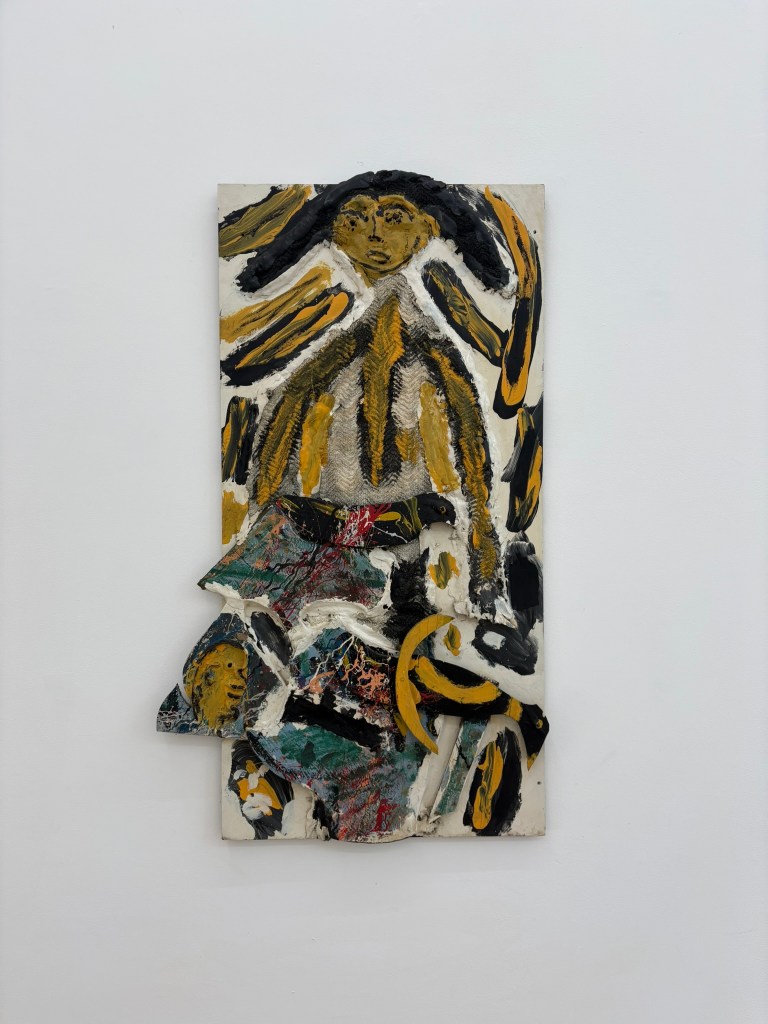
– Lady Loves To Put Pieces Back Together, 1989. Cloth, Splash Zone, glass marbles, wood, enamel on wood, 125.7 x 72.4 x 5.1 cm.
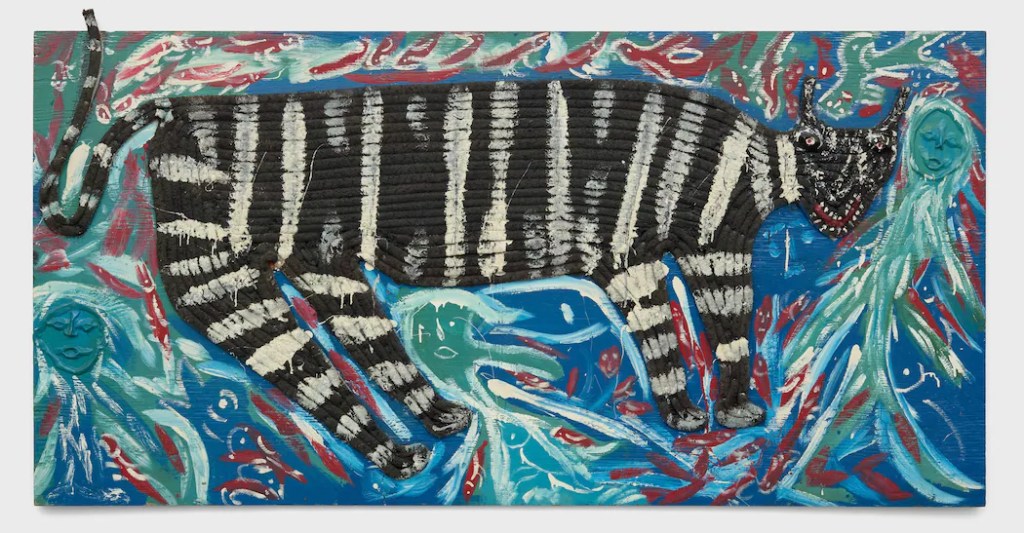
– If the Tiger Knew He Had So Many Friends He Wouldn’t Have Stayed in the Jungle So Long, 1989. © Thornton Dial. Courtesy of the artist and Arnett Children, photography by Tom Carter.
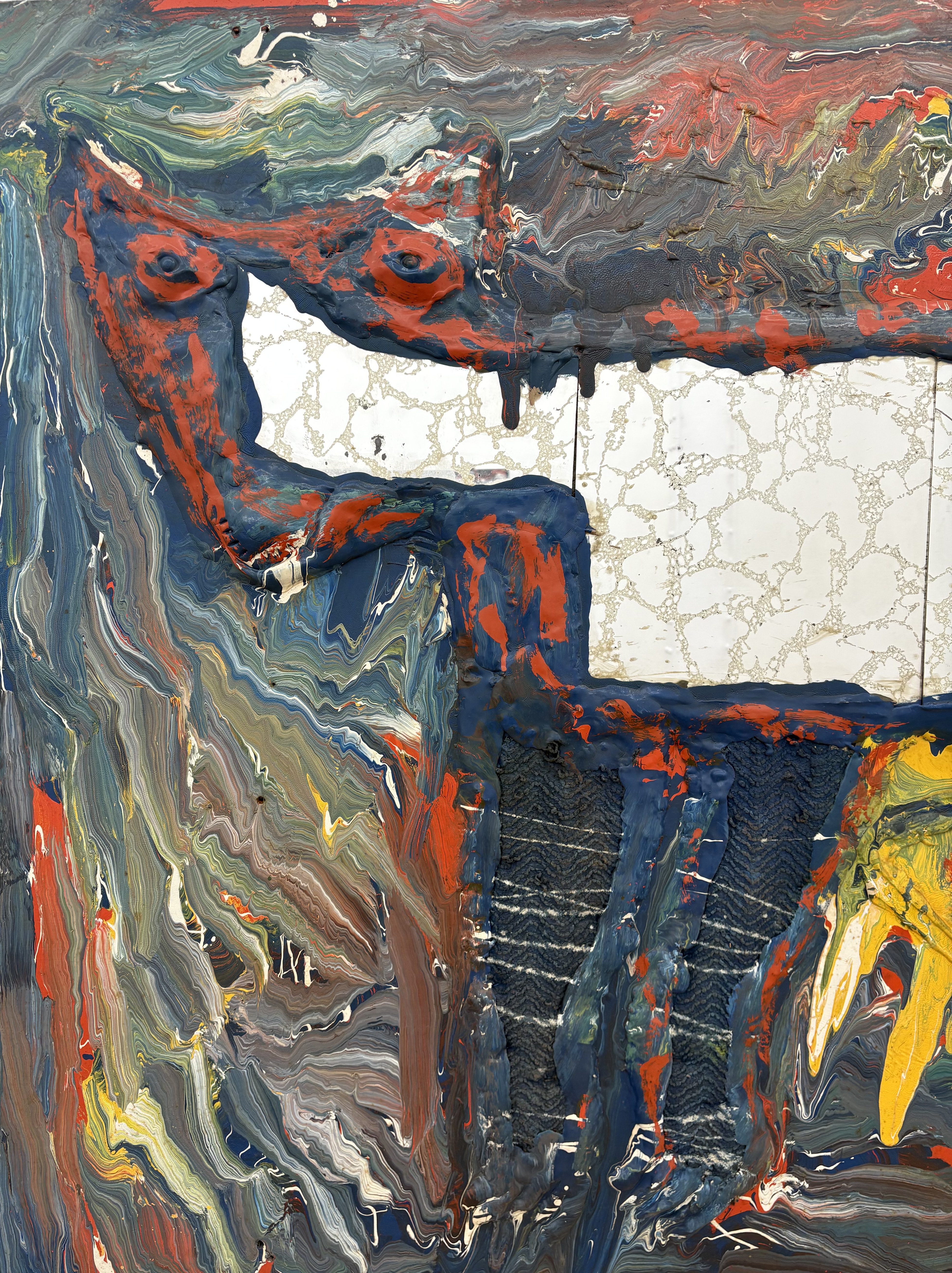
– Untitled, 1989.
Thornton Dial’s first UK solo exhibition of large-scale paintings and assemblages, ‘From Bessemer to the Cosmos’, is a reflection on the African-American experience across the twentieth century and beyond. Dial’s iconographic and figurative choices are twofold: narrating the genealogy of Black creativity that finds inspiration in the symbolic energies of junk, while, on a broader scale, paying tribute to the millions of unnamed workers whose labour often goes unrecognized.
Working since the age of five, Dial grew up in an America marked by the complex realities of class and racial disparities. He spent three decades as a metalworker at the Pullman Standard Plant in Bessemer, Alabama, and worked in a variety of skilled trades such as house painting, bricklaying, pipe fitting, and carpentry. That hands-on versatility, and his practical understanding of how different materials behave (rope, wire, cables, scrap metal), is likely what enabled him to build such a wide-ranging and complex practice.
The exhibition is structured around roughly ten works. Two pieces centered on the tiger figure, Untitled and If the Tiger Knew He Had So Many Friends He Wouldn’t Have Stayed in the Jungle So Long (both 1989), undoubtedly echo his 1993 solo show, Thornton Dial: Image of the Tiger, opened simultaneously at the New Museum and the American Folk Art Museum in New York. In Thornton Dial’s If the Tiger Knew He Had So Many Friends He Wouldn’t Have Stayed in the Jungle So Long, we see a tiger as a dog. The dog refers to visual traditions from West and Central African cultures that profoundly shaped the Americas (Yoruba, Ejagham, Kongo), while mirroring works like Twins Seven Seven’s The Devil’s Dogs.
In Untitled, a long central band of lace-patterned mirror glass sits at the core of a wide, horizontal panel of marbled, heavily worked paint in red, navy, ochre, and slate. But the image doesn’t stay contained within the artist’s own story—it also involves your living environment, and it pulls you into the work, forcing a confrontation with the self and with different viewpoints, ideas, races and personalities. Then, there’s the dog as a sign of sovereignty. Dial’s animal is shorthand for one man’s struggle, one man’s relation to the diaspora. If so, under this sign Dial compounds culture with identity.
Critics have often labeled Dial as an ‘outsider artist’, a category that confined the motivation and scale of his oeuvre—perhaps because he was a self taught artist and made work in a way that romanticized that idea. He didn’t have anything else than the material that he was left with. A lot of times it was stuff that he found along the way, that he combined with paint to create these beautiful parts of the black imaginary about freedom, flying, liberation and new destinations. But there is an obvious intellectual reach in his work that sits close to the concerns of many modern and contemporary artists, from Jackson Pollock and Robert Rauschenberg to Jean-Michel Basquiat, yet in a vernacular entirely his own.
From Bessemer to the Cosmos invited a critical look back at those moments—at the opening of an artist’s mind, the world’s response to it, and the remarkable work that emerged in the space between.
 プロテオドラ Theodora Poulot