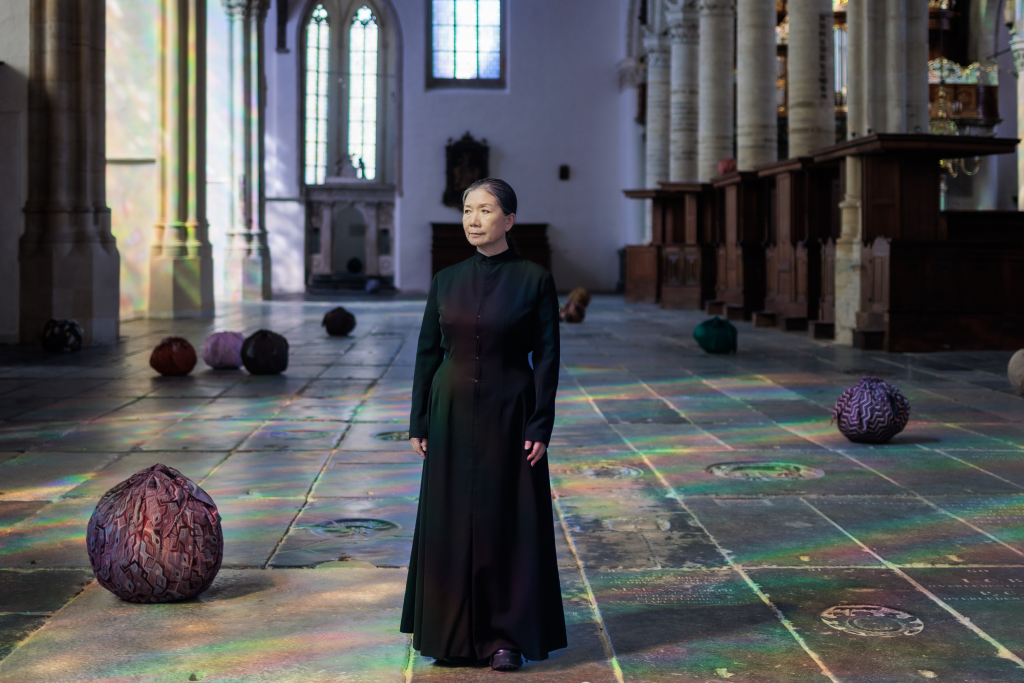
In her new site-specific installation To Breathe – Mokum, acclaimed Korean artist Kimsooja transforms Amsterdam’s oldest building into a contemplative space exploring themes of migration, displacement, belonging, and identity.
Presented during Amsterdam’s 750th anniversary, the installation reflects deeply on the city’s long and complex migration history, in a time in which in Europe and the Netherlands, national governments are enacting increasingly hostile policies towards individuals forced to leave their country of origin.
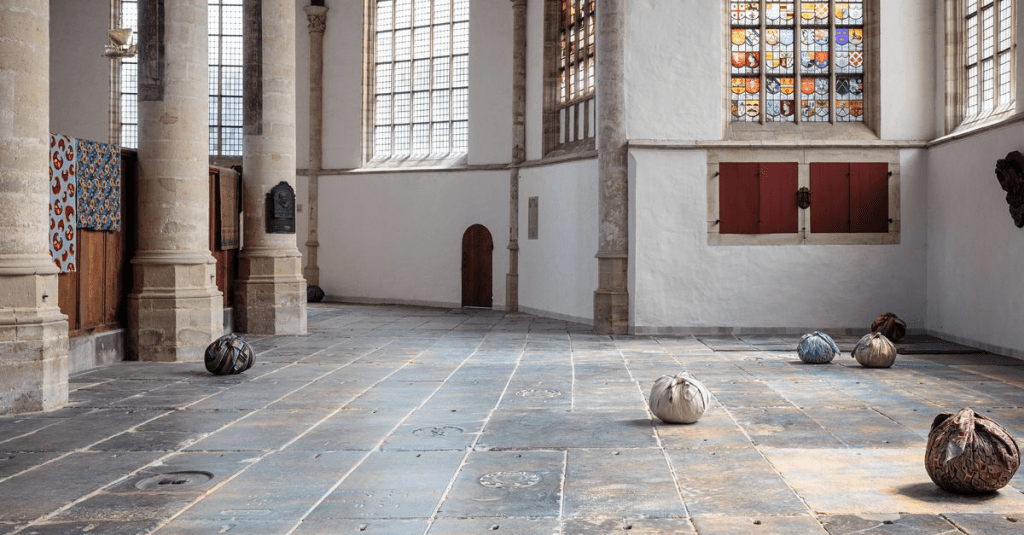
Today, Amsterdam is a city of more than 170 nationalities shaped by centuries of global movement. The Oude Kerk, at the heart of the historic harbour district, has long served as a place of arrival and departure: from 17th-century sailors drying their sails and praying for safe passage, to migrant couples who formalized their unions beneath its vaulted ceilings. In the 20th century, the emergence of Chinatown, Europe’s oldest Chinese neighborhood, further added to this narrative. The Oude Kerk is one of Amsterdam’s oldest buildings and has been a contemporary art space for years. The church setting lends itself to the contemplative qualities of the art it hosts.
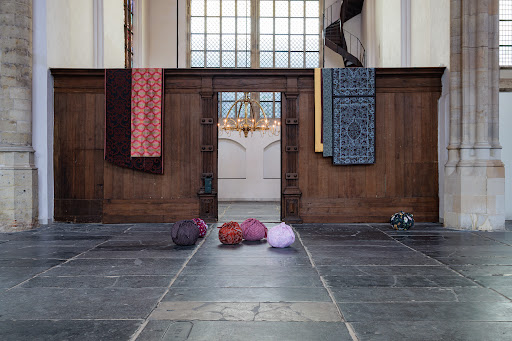
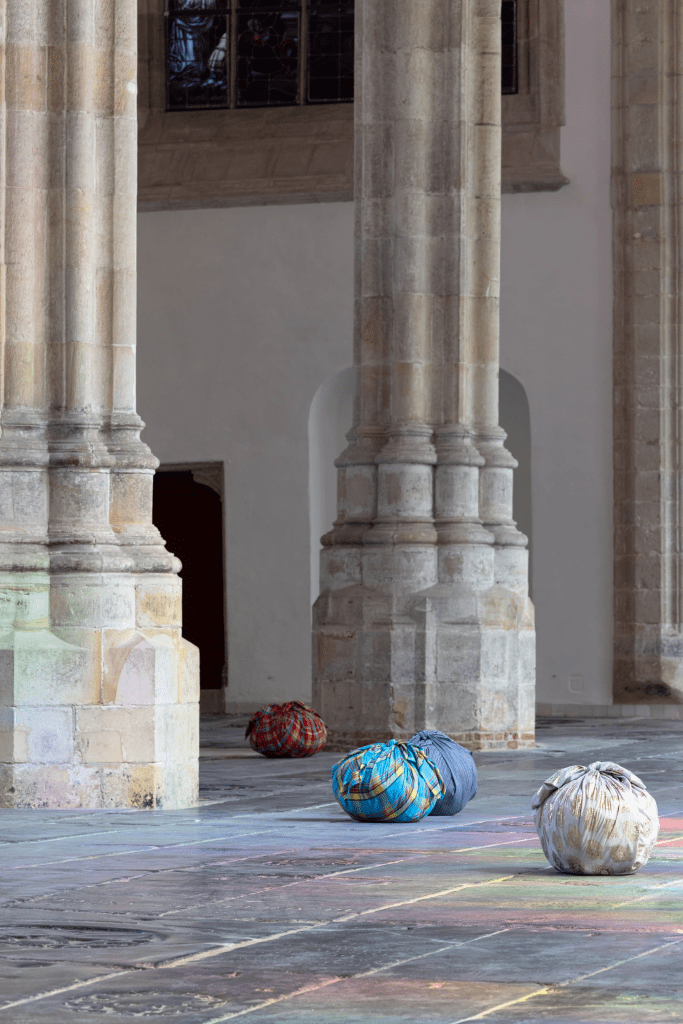
At the core of the installation is Kimsooja’s most expansive series of “bottari”:
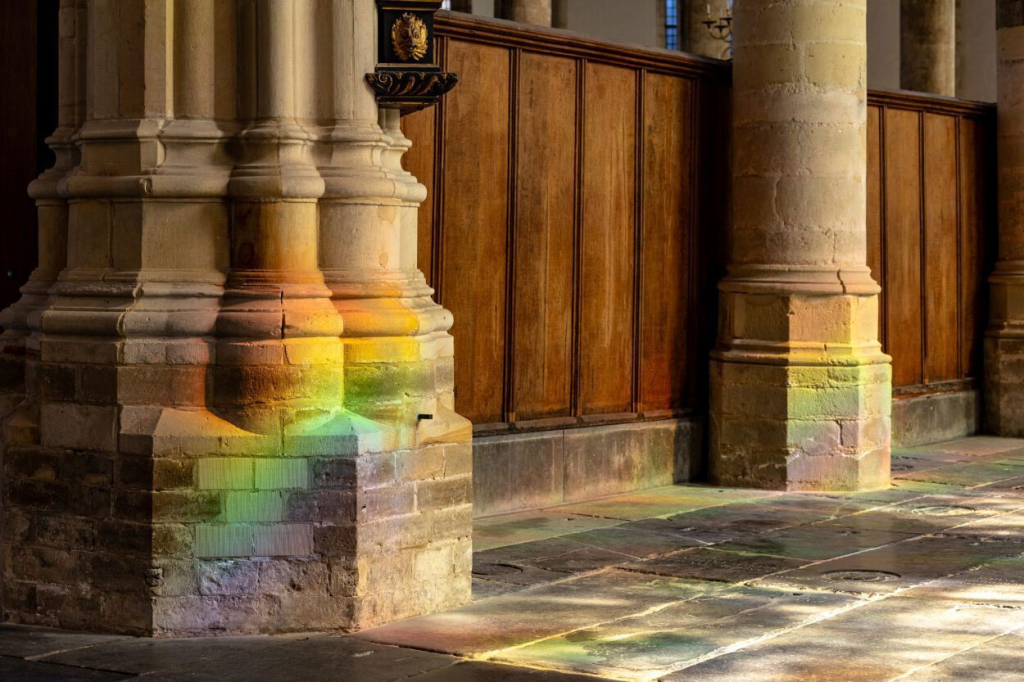
round, voluminous, traditional Korean travel bundles (in Korea traditionally seen as the ‘suitcases of the poor’). These bundles are filled with clothing donated by residents from across Amsterdam’s many communities and bathing in the miraculous rainbow light filtered through the Oude Kerk’s medieval stained glass windows that the artist covered with transparent film.
Depending on the weather and hour, some bundles bask in glorious rainbow light coming through the stained glass, while others remain untouched by any rays of warmth. Kim’s “bottari” work was first introduced in 1992, but the origin of the “bottari” is far older than 30 years. Arranged on the cold centuries-old gravestone floor of the church, the “bottari”, which symbolise people in transit, resonate with Amsterdam’s identity as a city of arrival and departure.Presented during Amsterdam’s 750th anniversary, the installation reflects deeply on the city’s long and complex migration history, in a time in which in Europe and the Netherlands, national governments are enacting increasingly hostile policies towards individuals forced to leave their country of origin.
The round, colorful “bottari” speak of movement, migration, and lives in transit. In contrast, the cold, hard gravestones beneath them recall stillness and death. Together, they create a dialogue between journey and rest, between searching and letting go.
Born in Daegu, South Korea, in 1957, Kimsooja is widely recognized as one of the most significant contemporary artists working today. Travel (both physical and spiritual) lies at the heart of her artistic practice. Drawing on her Korean heritage, Kimsooja engages with the universal and timeless theme of exile. Her multidisciplinary work spans installation, performance, video, and photography, exploring notions of identity, impermanence, and human interconnectedness.
“I would like to create works that are like water
and air, which we cannot possess but which can be shared with everyone.” — Kimsooja
“Migration” remains a deeply controversial topic in the West, where economic hardship often fuels waves of xenophobia. In times of uncertainty, it’s all too easy—and politically convenient—to cast immigrants as scapegoats. But history has shown us, again and again, the dangers of reducing people to faceless groups or mere statistics. Dehumanization is never far behind. The textiles of the bundles easily brings to mind the idea of “social fabric” currently being torn at from all directions. Each of Kimsooja’s bundles is unique, as we are all different from one another, yet together they inhabit the space in harmony.
“Migration” often requires leaving behind the tangible and intangible. Yet in those acts of loss and movement, there is also the potential to rebuild, to shape new identities, new communities, and new traditions from memory and adaptation. Kimsooja’s reflection on sharing and reinvention reminded me of an article I wrote on Asian diasporic foods, and the new recipes immigrants had to come up with when familiar ingredients were no longer available.
Kimsooja’s work has been exhibited extensively around the world. Recent solo exhibitions include the Bourse de Commerce in Paris (2024), Museum De Lakenhal in Leiden (2024), and the Guggenheim Museum Bilbao (2015). She represented South Korea at the 55th Venice Biennale in 2013 and participated in Documenta 12 in Kassel in 2007.
 プロテオドラ Theodora Poulot